In Memoriam: Robert A.F. Thurman (1941-2026)
It is with great sadness that the Department of Religion marks the loss of Professor Robert A.F. Thurman, who died on June 16, at home, in Woodstock, New York. A world-renowned scholar of Tibetan Buddhism, dedicated teacher, and public intellectual, Bob was the inaugural Jey Tsong Khapa Professor of Indo-Tibetan Buddhist Studies at Columbia, a chair he held from 1988 until his retirement in 2019. The author of numerous books, and stalwart champion of the translation of the Tibetan Tengyur, Bob inspired generations of Columbia and Barnard students in and beyond the classroom. He was also the co-founder of Tibet House here in New York City, and helped establish the Menla Retreat and Dewa Spa in Phoenicia, not far from Woodstock. A longtime friend and supporter of the Dalai Lama, in a letter to the Thurman family published yesterday His Holiness writes that “Bob lived a meaningful life and has left behind a legacy that will continue to inspire future students of Tibetan Buddhism and culture for generations to come. I am sure that the merit he accumulated through a lifetime of service to humanity will bear fruit in lives to come.”
If you would like to share reminiscences and condolences, please email the Department at [email protected]. A commemorative event in the Center for Buddhist Studies is being planned for the Fall 2026 semester.
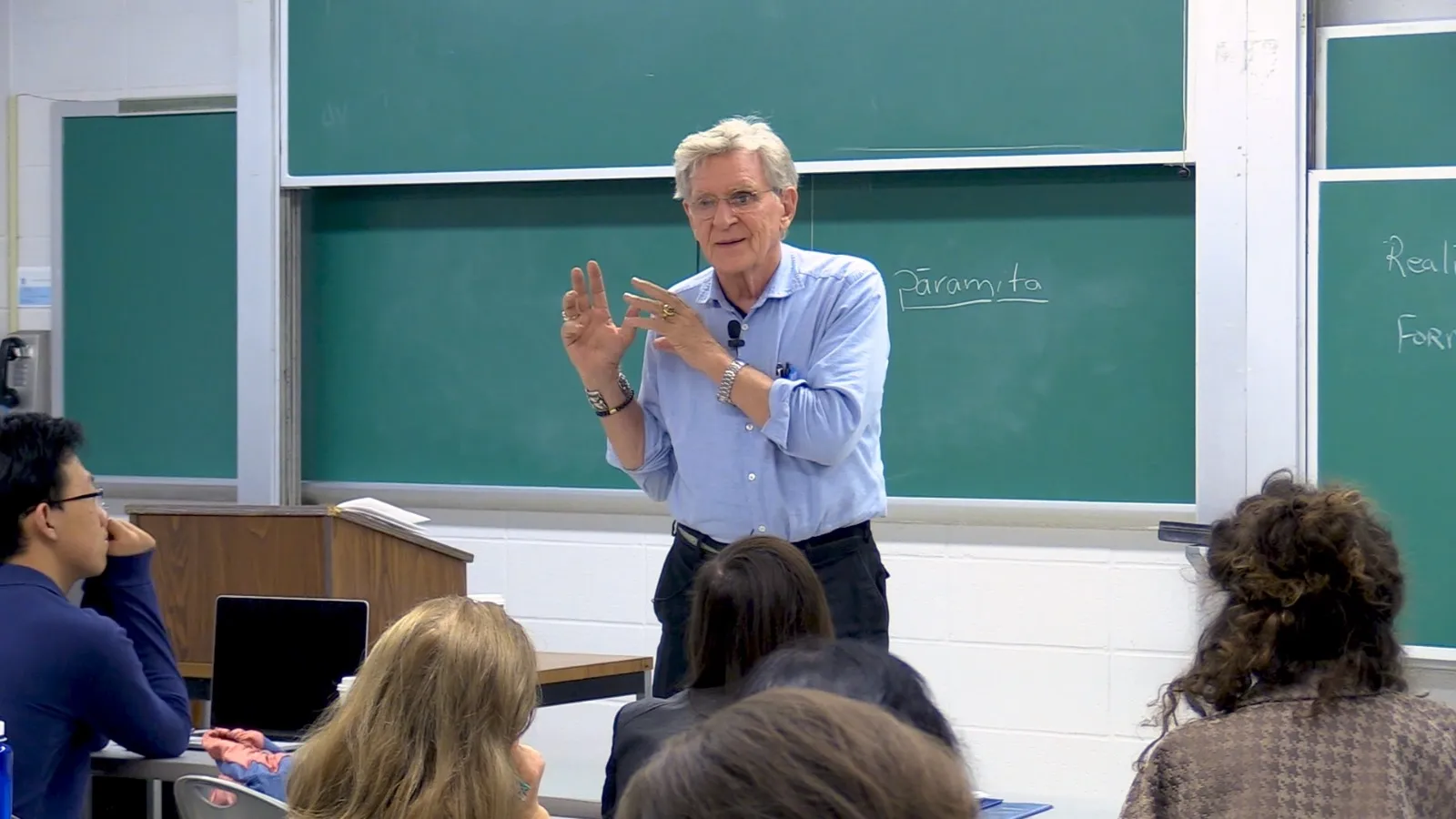
Robert Thurman, widely known as “Bob” or by his Tibetan name “Tenzin,” joined the faculty of Columbia University in 1988, when he inaugurated the Jey Tsong Khapa Chair of Indo-Tibetan Buddhist Studies. The chair was the first endowed professorship in the academic study of Buddhism in the United States, a milestone in the early development of the now-vibrant fields of Buddhist Studies and Tibetan Studies at Columbia and across the academy. Prior to arriving at Columbia, Thurman held a faculty position at Amherst College. He taught at Columbia until his retirement in 2019 and was exceptionally productive as an author, teacher, and public intellectual. He died peacefully of natural causes at his home in Woodstock, New York, on Tuesday June 16, 2026. The Dalai Lama, with whom Thurman shared a personal friendship for over 60 years, made the following statement: “As a Buddhist scholar, his knowledge was truly remarkable, including his command of the Tibetan language. He devoted his entire professional life to sharing that knowledge, not only with his students, but with the wider world through his writings and teachings.”
Thurman’s many, many students—those who went on to study Tibetan Buddhism and those who took up countless other paths—remember him as an inspiring, challenging, charismatic, humorous, and provocative teacher. His classrooms teemed with enthusiastic students, and often even introductory courses had to be limited to Religion majors and seniors since interest was so keen. In the days when Columbia’s campus was open to the broader New York City community, people from beyond the university would seek permission to join his demanding seminars on Buddhist ethics and philosophy, drawn by his extraordinary capacity to illuminate the insight and relevance of Tibetan approaches to the arts and sciences.
Professor Thurman often read aloud from his translations of Tibetan Buddhist texts in class, demonstrating their liveliness and humor as much as their profound insights. His facility with language and his insight into diverse philosophical arguments brought fluidity and dynamism to his teaching. He was a captivating storyteller and he wove narrative into his lectures, enlivening even the most dense materials. He often sparked debates with students and aimed to meet them wherever they were in their evolving knowledge of key concepts such as emptiness and interdependence. He might show disappointment, but only if a student hesitated to spar with him.
For decades, Thurman was a major force on campus and beyond. He inspired many younger scholars who have gone on to train their own graduate students and deepen scholarly and popular understandings of Tibetan religion, literature, and history. Gray Tuttle, Department Chair of East Asian Languages and Cultures, reflects, “Bob Thurman was a pioneer in pursuit of Tibetan Buddhism. In my own career, he was there from my earliest interest in Tibet, when I hosted him as the keynote speaker for a new student group dedicated to Tibet at Princeton in 1990, to my hiring at Columbia as the Luce Chair of Modern Tibet, a position Bob played a key role in securing. His dramatic presence and publications changed the way Tibetan Buddhism was understood by the American public.” Beyond EALAC and the Religion Department, Thurman vigorously supported the work of Columbia’s Weatherhead East Asian Institute to establish the Modern Tibetan Studies Program in 1999. Recognizing the need for research and active engagement with contemporary Tibetan society in the People's Republic of China and the diaspora, this thriving Tibetan Studies program hosts large-scale events, book talks, and scholarly workshops. The most recent conference focused on an avid concern of Thurman’s—living with climate change in the Himalayan region and on the Tibetan plateau.
Annabella Pitkin, Associate Professor of Buddhism at Lehigh University, was Thurman’s doctoral student in the early 2000s. She recalls, “Working with Bob as a graduate student was a transformative experience. Classes with him were terrifying, exhilarating, mind-opening. He was a thrilling teacher, who shared his deep love for the riches of Tibetan literature and the vivid illuminations of Tibetan Buddhism with his students. He demanded that we throw ourselves into the struggle for knowledge with the same passion he did. His generosity in flinging open the gates of learning will stay with me always. He roared like the lion’s roar of wisdom in the Vimalakīrti Sūtra that he so loved and rendered into English so eloquently. His passion for the enduring brilliance of Tibetan civilization and the urgency of Tibetan cultural survival were a central part of his lifelong commitment to human flourishing.”
Robert A.F. Thurman was born on August 3, 1941, in New York City. His mother was an actress and his father was a news editor. He is remembered as an intellectually curious child, and that quality remained predominant in his personality until his last days. As a student at Harvard University in the early 1960s, he had an accident while fixing his motorcycle that blinded him in one eye. He often referred back to that experience when telling large lecture halls of students how he became interested in Buddhism in the first place. Somehow the loss of his eye sparked his urge to seek out new ways of seeing the world.
Soon after the accident, he took a break from Harvard and traveled to India, where he met the Dalai Lama in 1964. This was the beginning of a vibrant and formative connection. While in India, Thurman became the first American to take ordination as a Tibetan Buddhist monk, joining a monastery in Dharamsala, home to a large community of Tibetans living in exile. Several of his contemporaries, who would likewise become major figures in the field of Buddhist studies, took a similar trajectory, each of them eventually moving from the monastery to the academy. During Thurman’s time as a monk, he was particularly inclined to the Tibetan practice of philosophical debate, which can be a raucous and sporting opportunity for students of Buddhist philosophy to hone their skills and play devil’s advocate. He sometimes joked with Columbia students that he was a bit too enthusiastic in his efforts to best his opponents and his teachers encouraged him to tone it down.
Back in the United States, Thurman became very close with Geshe Wangyal, an influential Mongolian scholar who founded a center in New Jersey and was a major figure in the establishment of Tibetan Buddhist practice in the US. Geshe Wangyal encouraged Thurman to give up his monastic vows and pursue an academic path instead. Thurman married Nena von Schlebrügge in 1967 and they went on to have four children—Ganden, Uma, Dechen, and Mipam. He also had a daughter, Taya, from an earlier marriage before he was ordained as a monk. After marrying Nena, his lifelong partner, Thurman returned to Harvard and wrote his doctoral dissertation on the philosophical teachings of Jey Tsong Khapa (1357-1419), the great Tibetan scholar and poet for whom his chair in Indo-Tibetan Buddhist Studies at Columbia was later named. Under the supervision of Masatoshi Nagatomi, he earned his Ph.D. in Sanskrit and Indian Studies from Harvard in 1972.
In addition to his passion for awakening Columbia undergraduate and graduate students to the richness of Tibetan Buddhist literatures and his dedication to raising awareness about the importance and richness of Tibetan cultures, Thurman was focused on the monumental task of translating the Tibetan Tengyur. The Tengyur is the Tibetan Buddhist canonical collection of over 4,000 texts and commentaries including philosophy, psychology, ethics, linguistics, medicine, meditation, yoga, astronomy, and political theory. Throughout the 2,500 year history of Buddhism, which originated in India and migrated to Tibet in around the 8th century, Buddhists across the world have dedicated immense resources, time, and expertise to the translation of Buddhist source texts into the target languages of the societies where Buddhism spread. The Buddhist textual canon is massive and complex, so the project of translation requires teams of experts and takes many years. Thurman took part in that long history by committing to oversee the translation of the complete Tibetan Tengyur into English. He often remarked that he had promised The Dalai Lama and Geshe Wangyal that he would complete this historic labor, even if it took multiple lifetimes!
This work is ongoing and involves many translators, editors, and publishing experts. Thurman and his former student Tom Yarnall, Associate Research Scholar in the Department of Religion, edited the publications, and Yarnall will continue that work. The translations are co-published by the American Institute of Buddhist Studies and Wisdom Publications in association with the Columbia University Center for Buddhist Studies and Tibet House US in the series Treasury of the Buddhist Sciences. This series is an active and ongoing project which includes 38 published volumes to date. Two more volumes will be published later this year, and ten more are in process for publication over the next few years.
Yarnall expresses his experience working with Thurman as follows: “For almost five decades I have been inspired to learn from Bob's unique, shining genius as an interpreter and scholarly translator of classical Indo-Tibetan Buddhist works. This genius, which clearly grounded and informed his teaching, shone not only through his unmatched, fluent command of classical Sanskrit and Tibetan languages, literary genres, and complex technical terminologies, but also—indeed more so—through his deep understanding of the content of the source material and his exceptional ability to evocatively translate this content into the idioms of contemporary disciplines, paradigms, and practices. In these ways, Bob demonstrated how these rich classical works could be brought to life for contemporary audiences (scholarly and popular alike) without compromising academic rigor or fidelity to the historical and intellectual contexts of the source material. Bob’s brilliant, innovative translations/interpretations have been widely acclaimed and frequently (even when gradually) adopted over time. His interdisciplinary, cross-cultural, evocative approaches to the translation/interpretation of the source materials of the Indo-Tibetan Buddhist traditions will serve as an exemplary model and a guiding light for future generations of fortunate students, scholars, and translators of these profound and magnificent traditions.”
His prolific translation work encompassed both classical Sanskrit Buddhist texts and major works of the Tibetan Buddhist tradition. Among his translations of canonical Indian Buddhist texts were the Vimalakīrti Sūtra and, together with Lozang Jamspal and collaborators, Maitreya's Mahāyānasūtrālaṃkāra (The Universal Vehicle Discourse Literature) along with Vasubandhu's commentary. Thurman was also a pioneering interpreter and translator of the Madhyamaka, or "Centrist," philosophy of Jey Tsong Khapa, as well as Tsong Khapa's writings on tantric theory and practice. In this domain, his translations included Tsong Khapa's philosophical magnum opus, The Essence of True Eloquence, and Brilliant Illumination of the Lamp of the Five Stages, Tsong Khapa's most influential commentary on the Guhyasamāja Tantra. He also produced a groundbreaking translation of the Tibetan Buddhist classic, The Tibetan Book of the Dead: The Great Book of Natural Liberation through Understanding in the Between. Allison Aitken, Assistant Professor of Philosophy, characterizes his legacy in this way: “In his trailblazing work transmitting Tibetan Buddhist concepts, arguments, and practices to the English-speaking world, Thurman developed a distinctive, imaginative, and often unconventional style of translation. Attentive to both the aesthetics of language and its phenomenological effects on readers, he brought Buddhist ideas vividly to life while preserving their philosophical depth.” When Thurman used his own translations in his courses, he offered students an intimate understanding of the kind of decision making that goes into the art of translation.
Around the same time he began teaching at Columbia, he co-founded Tibet House US in 1987 alongside Richard Gere, Philip Glass, and others. Tibet House is dedicated to preserving and presenting the cultural heritage of Tibet, and he served as its president for decades thereafter, remaining an active presence there until his final days. According to David Kittay, Adjunct Lecturer in Religion at Columbia and Board member at Tibet House, “Thurman was super-inspiring at every level of teaching and scholarship. He brilliantly illuminated the spirit and insights of Buddha and his many Tibetan partners. His scholarship was not only profound and far-reaching, but creative beyond anything I have seen. Bob emphasized the identity of wisdom and compassion and he practiced it every day, in real life with real people. In addition to making Buddha’s teachings understandable to people of all faiths and backgrounds, he plumbed the depths of Tibetan and Sanskrit literature and philosophy, investigating, teaching, and practicing the Tibetan technology of consciousness and service to all beings everywhere, in partnership with his good friend, mentor, and co-explorer, His Holiness the Dalai Lama. And all of this with his wit and amazing energy, his ‘buddhas have more fun’ spirit, and his personal warmth and friendship. We were so lucky to have him!”
Thurman maintained an active international schedule of lectures, teachings, and public appearances. In 2010, he launched the long-running Bob Thurman Podcast, and throughout his later years he continued to lead retreats, lecture series, and educational programs on Tibetan Buddhist philosophy and practice around the world, including at the Menla Retreat Center in the Catskills, a project of Tibet House US. He also authored numerous books for a general audience, including Inner Revolution: Life, Liberty, and The Pursuit of Real Happiness and Why the Dalai Lama Matters: His Act of Truth as the Solution for China, Tibet, and the World, a political and spiritual defense of the Dalai Lama’s “Middle Way” approach, advocating for meaningful Tibetan autonomy within the People's Republic of China.
Tenzin Dorjee, Adjunct Assistant Professor of Political Science at Columbia, recalls, “Bob Thurman was a genuine friend of the Tibetan people and a fearless champion of the Tibetan cause. I was so fortunate to come in contact with him during my time at Students for a Free Tibet. He was extremely kind and brilliant in every interaction, giving his time, wisdom, and energy generously whenever we asked him to join a panel or to speak at the Tibetan Uprising Day rally. One time during a rally outside the UN, he gave the entire speech in Tibetan, electrifying the crowd and confusing passersby! He always believed in the possibility of a free Tibet no matter what the odds and never hesitated to take a stand for truth and justice no matter what the personal cost. As a good Buddhist, he believed oppression too was impermanent.”
Thurman also authored outstanding books on Tibetan Buddhist art, including Wisdom and Compassion and Worlds of Transformation among many others. He contributed to biographical works intended for broad audiences such as Man of Peace: The Illustrated Life Story of the Dalai Lama of Tibet. He advised no fewer than thirty successful doctoral dissertations in the Department of Religion, and oversaw scores of undergraduate projects and MA theses. After retiring from Columbia in 2019, Thurman continued to devote himself to public scholarship, serving both as an influential teacher of Tibetan Buddhist thought and as a prominent advocate for the preservation of Tibetan culture, literature, and religious traditions.
In memoriam statement compiled and edited by Dominique Townsend, Jey Tsong Khapa Chair of Indo-Tibetan Buddhist Studies in the Department of Religion
Selected publications authored and co-authored by Robert A.F. Thurman (from his 2019 CV):
The Door of Liberation, with Geshe Wangyal. New York: Girodias Press, 1970.
Holy Teaching of Vimalakirti, trans. University Park: Penn State University Press, 1977.
"Buddhist Hermeneutics." Journal of the American Academy of Religion, March 1978.
"Voidness and Totalities: Madhyamika and Hua Yen Thought." In Studies in Pali and Buddhism, edited by A.K. Narain. Delhi, 1978.
"The Politics of Enlightenment." Lindisfarne Letter 8, Winter 1979.
"Tibetan Buddhism Faces Modernity." Bulletin of the Harvard Center for the Study of the World Religions, 1979.
"Philosophical Non-egocentrism in Wittgenstein and Candrakirti and the Private Language Question." Philosophy East and West, June 1980.
"Tsong Khapa on Analytic Meditation." Tibet Journal, May 1980.
"Interiority and Confrontation in Buddhist Religious Experience." In The Other Side of God: Monotheism and the World Religions, edited by Peter Berger. New York: Doubleday, 1981.
"Transcendence and the Sacred in Mahayana Thought." In Transcendence and the Sacred. Notre Dame: Notre Dame Press, 1981.
"Buddhist Ethics: Emptiness and Compassion." Religious Traditions, November 1981.
The Life and Teachings of Tsong Khapa. Dharamsala: Library of Tibetan Works and Archives, 1982.
"Terras Irradient: Western Liberal and Buddhist Liberative Arts." In Appalachian Journal of Higher Education, edited by P. La Chance, 1982.
"Buddhist Social Activism: Nagarjuna's Welfare State." The Eastern Buddhist, May 1983, 19–52.
"The Dalai Lamas of Tibet." Tibet Journal, December 1983.
"Buddhist Views of Nature." In On Nature, edited by L. Rouner. Notre Dame: Notre Dame Press, 1984.
"Beyond Buddhism and Christianity: New Definition of the Dialogue of World Religions." Buddhist-Christian Studies. Honolulu: University of Hawaii Press, 1984.
"Tsong Khapa on Integration of Sutra and Tantra." In Tibetan Studies, edited by Aziz and Kapstein. Wiesbaden: Harrassowitz, 1984.
Speech of Gold: Reason and Enlightenment in the Central Philosophy of Tibet. Princeton: Princeton University Press, 1984.
Lectures on Buddhist Inner Science, with H. H. Dalai Lama. Amherst: AIBS, 1984.
From the Land of Snows: Buddhist Art of Tibet, with M. Rhie. Amherst: Mead Museum, 1984.
"Tibetan Monastic Education." In Padma Karpo – In Celebration of Tibetan Culture, edited by C. Eilchert. New York: Snow Lion Press, 1985.
"The Bodhisattva: Buddhist Messiah." In Christ and the Bodhisattva, edited by D. Lopez and S. Rockefeller. Albany: SUNY Press, 1987.
"Vajra Hermeneutics." In Buddhist Hermeneutics, edited by D. Lopez. Kuroda Institute Series. Honolulu: University of Hawaii Press, 1987.
"Homage to Nishitani." In Religion and Nothingness, and Its Challenge to Western Thought, edited by T. Unno. Nanzan Institute for Philosophy and Religion Series. Berkeley: University of California Press, n.d.
"The Cultural Inheritance of Tibet." Cultural Survival. Cambridge: Harvard Press, 1988.
The Central Philosophy of Tibet. Princeton: Princeton University Press, 1991.
Wisdom and Compassion: The Sacred Art of Tibet, with M. Rhie. New York: Harry Abrams, 1991.
MindScience, edited with Daniel Goleman. Boston: Wisdom Publications, 1991.
"The Spirituality of Emptiness." In Encyclopedia of Spirituality, vol. 2. New York: Crossroad/Continuum, 1991.
"Tibetan Psychology: Sophisticated Software for the Human Biocomputer." In Mind Science, East and West, edited by Robert Thurman and Daniel Goleman. Boston: Wisdom Publications, 1991.
"A Glimpse of Shambhala." In The Way Ahead, edited by Shapiro. London, 1992.
The Tibetan Book of the Dead: The Natural Liberation Through Understanding in the Between, trans. New York: Bantam Publications, 1993.
"Human Rights and Human Responsibilities: Buddhist Theories of Justice." In Human Rights in the World Religions, edited by W. de Bary, W. Proudfoot, and I. Bloom. New York: Columbia University Press, 1993.
Inside Tibetan Buddhism. San Francisco: HarperSanFrancisco, 1995.
Essential Tibetan Buddhism. San Francisco: HarperSanFrancisco, 1995.
"The Tibetan Way of Dying." In Death and the World Religions, edited by H. Obayashi. Chicago: University of Chicago Press, 1995.
"The Buddha's Smile: Buddhism on the Pursuit of Happiness." In On Happiness. Boston University Institute of Philosophy and Religion. Notre Dame: Notre Dame Press, 1995.
Wisdom and Compassion: The Sacred Art of Tibet, expanded ed., with M. Rhie. New York: Harry Abrams, 1996.
Mandala: The Architecture of Enlightenment, with Denise Leidy. New York: Tibet House and Asia Society, 1997.
"Tibetan Culture Under Threat Today." In Tibetan Art. Albuquerque Museum, 1998.
"Spiritual Traveling." Travel, 1998.
"Win-Win Solution for Tibet and China." Wall Street Journal, 1998.
Inner Revolution: Life, Liberty, and the Pursuit of Real Happiness. New York: Riverhead Books, 1998.
Worlds of Transformation: Tibetan Art of Wisdom and Compassion, with M. Rhie. New York: Tibet House, 1999.
Circling the Sacred Mountain: A Spiritual Journey Through the Himalayas, with Tad Wise. New York: Bantam, 1999.
"Tibetan Buddhism in America." In Religions in America, edited by T. Tweed. Chapel Hill: University of North Carolina Press, 2001.
Infinite Life: Seven Virtues for Living Well. New York: Riverhead Books, 2004.
Anger. New York: Oxford University Press, 2004.
The Jewel Tree of Tibet. New York: Macmillan Free Press, 2005.
Why the Dalai Lama Matters: His Act of Truth as the Solution for China, Tibet, and the World. New York: Simon & Schuster Atria/Beyond Words Books, 2008.
The Brilliantly Illuminating Lamp of the Five Stages: A Study of the Perfection Stage of the Unexcelled Yoga Tantras. New York: American Institute of Buddhist Studies/Columbia Center for Buddhist Studies/Tibet House US/Columbia University Press, 2013.
Love Your Enemies, with Sharon Salzberg. New York: Hay House, 2014.
Man of Peace: The Illustrated Life Story of the Dalai Lama of Tibet, with W. Meyers and M. Burbank. New York: Tibet House US/Hay House International, 2016.